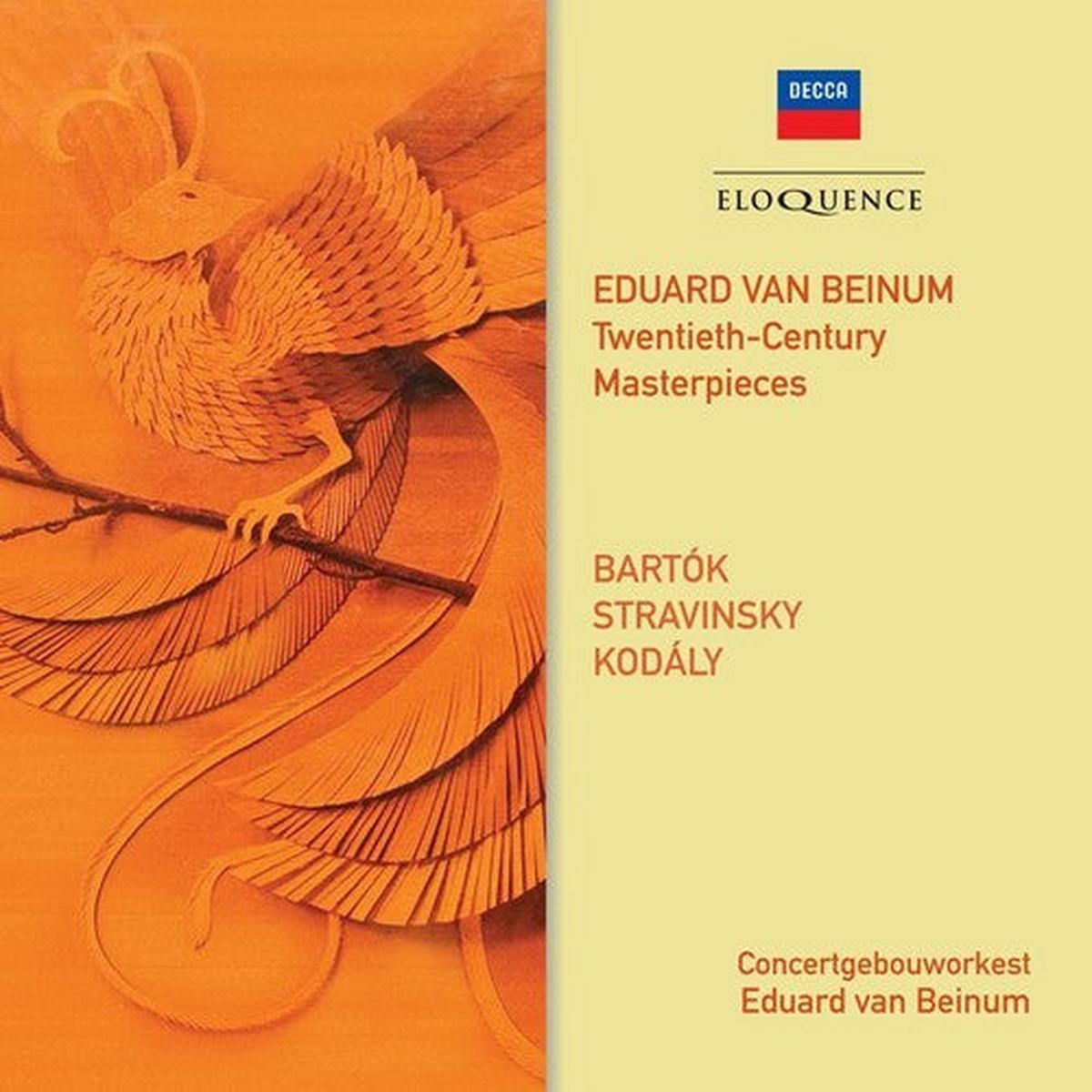
The recorded legacy of Eduard van Beinum has been extensively documented on Eloquence. Previous issues have revealed the Dutch conductors mastery of and sympathy for 20th century composers such as Sibelius (4429487) and Britten (4802337). His clear-headed approach to any score, combined with the refinement of the Concertgebouw Orchestra, particularly suit the music of Bartk and Stravinsky represented here. At the same time, Van Beinum was renowned for a fastidious ear in the matter of orchestral colour he could draw out a full palette of sonority in works such as the Symphonie fantastique of Berlioz (also on Eloquence, 4825569) and Rimsky-Korsakovs Scheherazade (4825511), a palette which is further tinted and enhanced by the twanging cimbalom in the uproarious suite from Kodlys Hry Jnos to conclude this album.
In the repertoire of Willem Mengelberg, Van Beinums predecessor at the Concertgebouw, the enthusiasm for music of his own time did not extend much beyond that of his friend Gustav Mahler, and native fellow-Dutch composers. It fell to the younger man, when he finally took full charge of the orchestra in 1945 after sharing responsibility with Mengelberg for several years, to update its repertoire. He did this by casting his net across European modernism and its most distinctive voices. Folksong, whether real or invented, was central to the different idioms of the three composers here, from Stravinskys use of old Russian tunes in his sensational first commission for the Ballets Russes of Serge Diaghilev, The Firebird of 1910 (Van Beinum conducts the suite made in 1919) to the unmistakably Hungarian sound of both Hry Jnos (1926) and Bartoks late Concerto for Orchestra of 1943. The most adventurous music here may not even be heard in the archaic savagery of The Rite of Spring (a recording that set new standards for precision in this complex score when first issued in 1948, still on 78s) but in the 1956 recording of another suite, extracted by from his magical, mechanical opera of 1914, Le Rossignol (The Nightingale).
An uncommonly sound performance and a truly brilliant recording, bringing out more of the score than I should have thought possible. Gramophone, March 1948 (Le Sacre du printemps)
A triumph of engineering and conducting. In no other version will be the cimbalom sound as clear. Gramophone, January 1957 (Hry Jnos)
[Van Beinum] takes a thoroughly Romantic view of this music, giving a performance that emphasises its links with the Rimsky of Coq dOr and Scheherazade the beautiful playing of the Concertgebouw woodwind, and the recorded tone is warm to match. Gramophone, March 1958 (Le Chant du rossignol, LOiseau de feu)
Bartk: Concerto for Orchestra, BB 123, Sz.116
Bartk: Music for Strings, Percussion & Celesta, BB 114, Sz. 106
Kodly: Hry Jnos Suite
Stravinsky: Le Chant du Rossignol
Stravinsky: The Firebird Suite
Stravinsky: The Rite of Spring


![(Maxi Single) Flamingo/TEENAGE RIOT by Kenshi Yonezu [Regular Edition]](https://www.musicrecordpro.com/wp-content/uploads/2026/09/29/1790677632/maxi-single-flamingo-teenage-riot-by-kenshi-yonezu-regular-edition.webp)
![Tabea Zimmermann / Ensemble Resonanz * Enescu: String Octet Op 7 Britten [New CD]](https://www.musicrecordpro.com/wp-content/uploads/2026/09/29/1790677632/tabea-zimmermann-ensemble-resonanz-enescu-string-octet-op-7-britten-new-cd.webp)